
Traditional vs. Induction Heating:
The Advantages of Induction Heating in Manufacturing
If you’re still heating with a torch, you’re likely dealing with quality and safety issues and other manufacturing concerns on each and every job. Induction heating provides precise, repeatable control over the rate of temperature rise, the exact temperature achieved, and the precise location of heat application.
Read our article to learn more about the advantages of induction heating as compared to torch heating.
Ready to make the switch? Talk to one of our induction heating experts today.
How Induction Heating Works
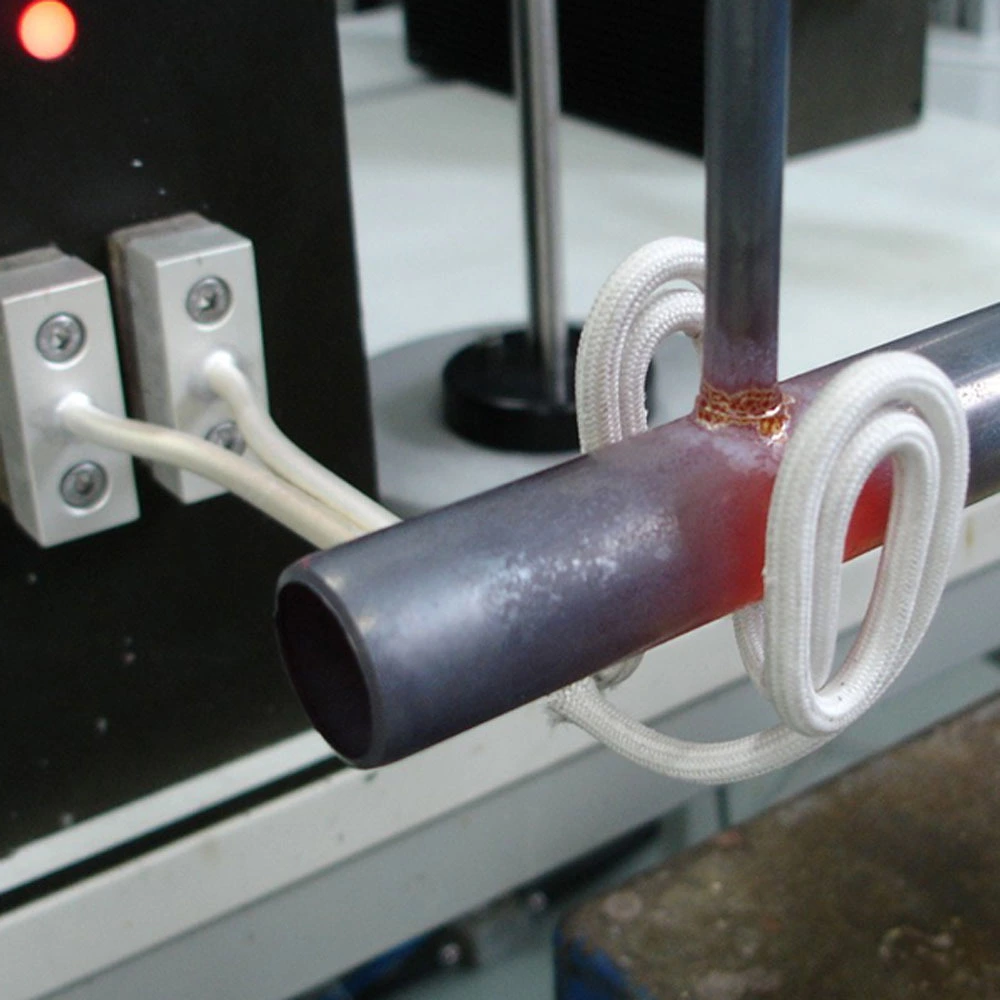
Induction heating is a process where metal objects, whether magnetic or non-magnetic, are heated by placing them within a varying magnetic field generated by eddy currents.
When alternating current passes through a specially designed coil, it creates a magnetic field within that coil. When inserting your workpiece into this field, the magnetic energy wraps around the metal at an incredibly high rate. For example, at 50kHz frequency, the field cycles 50,000 times per second, generating heat directly inside the material itself.
Unlike traditional heating methods, there's no open flame or external heat source. The electromagnetic field produces heat precisely where you need it, allowing you to target specific areas down to an exact band, joint, or feature.
With your induction heating machine, you can fine-tune the power level, time, and frequency to create repeatable, consistent results for every production run. Additionally, the coils themselves can be customized to match your exact heating requirements, ensuring energy is focused only where it's needed.
Disadvantages of Torch Heating
- Having an open flame in the manufacturing facility is becoming more undesirable. It’s highly unsafe and requires Oxy-Acetylene cylinder management and storage.
- Torch brazing, if not managed correctly, can be unsafe – we have seen kerosene-soaked sags set afire because open flame torches were not handled correctly
- Torch brazing requires a consistent, repeatable process, which at times cannot be achieved without a highly qualified operator. There’s no tight quality control and no way to document or reliably repeat results.
- Torch brazing may inadvertently heat other areas of the assembly, not just the braze joint. The brazing torch has to be moved back and forth and all the way around the joint to try to apply even and consistent heating, which can be very hard to achieve.
- Torch heating can incur long net heating times, whereas induction can reduce heating time to seconds.
Process Applications Where Induction Shines
Brazing
Repeatable, clean heat at the joint line improves filler flow and joint integrity. The precise temperature control ensures optimal capillary action, while the localized heating prevents damage to adjacent materials or pre-assembled components. This results in stronger, more consistent joints with minimal post-process cleanup.
Hardening
Consistent case depth and pattern control on shafts, gears, and edges. Induction allows you to selectively harden wear surfaces while maintaining a ductile core for toughness. You can achieve precise hardness patterns and targeted temperature requirements.
Shrink Fitting
With induction heating, you can heat the specifically targeted part of the assembly to the exact target temperature and then start the shrink fitting process quickly and consistently. With induction heating, you can always apply the same amount of focused heat each and every time.

Is Induction a Fit for My Operation?
Induction heating isn't just about replacing torches; it's about making your heating process into a competitive advantage. While the technology excels in many applications, understanding where it delivers maximum value helps justify the investment.
You'll get the biggest ROI if you:
- Run moderate-to-high volumes or repeat jobs: The initial coil and equipment investment pays off quickly when you're processing dozens or hundreds of parts daily, especially when consistency is critical.
- Need tight temperature windows or narrow heat zones: When your process demands ±10°F accuracy or heating a specific 1/4" band without affecting adjacent areas, induction's precision becomes invaluable.
- Want to reduce scrap or rework tied to operator variability: If inconsistent heating is causing quality issues, failed audits, or customer complaints, induction's repeatability can transform your quality metrics.
- Are you managing EHS concerns around open flames and gas storage: Whether driven by insurance costs, safety incidents, or regulatory compliance, eliminating open flames and gas cylinders can significantly reduce your risk profile and associated costs.
Get Started with an Induction Heating Solution Today
Ready to compare torch vs. induction options on your parts? Contact us to speak with an Inductronix applications engineer. We’ll help you tailor a solution to ensure your heating process is optimized for your industrial application.
FAQs
Will induction heating work on my material?
Induction heats all electrically conductive metals. Ferrous materials (steel, cast iron) heat most efficiently, while non-ferrous metals like copper, aluminum, and brass require optimized frequency and power settings but heat very effectively. Even non-conductive or hard-to-work-with materials can be heated using conductive susceptors, such as glass, various R&D materials that cannot be heated directly, very small particles, and fiber optics.
How precise is temperature control with induction?
Standard systems offer repeatable power and time control. For applications requiring ±10°F accuracy, we can integrate pyrometers or thermocouples for real-time closed-loop temperature control, ensuring you hit your target temperature every time without over- or undershooting.
Can induction heating handle different part sizes without changing equipment?
Yes. We design modular systems with interchangeable coils. Switch between different part geometries quickly by swapping coils and loading the corresponding heating recipe. One power supply can support multiple applications (within reason, depending on the part material, size, and geometry).
How much maintenance does an induction system require?
Minimal. Unlike torches that need tip cleaning and gas system maintenance, induction systems primarily need cooling water checks and occasional coil inspection. Most systems run thousands of hours between service intervals, with coils lasting years in normal operation. There are no consumable parts in induction heating.