
How to Evaluate Automation for Induction Heating
A Practical Guide for Manufacturing
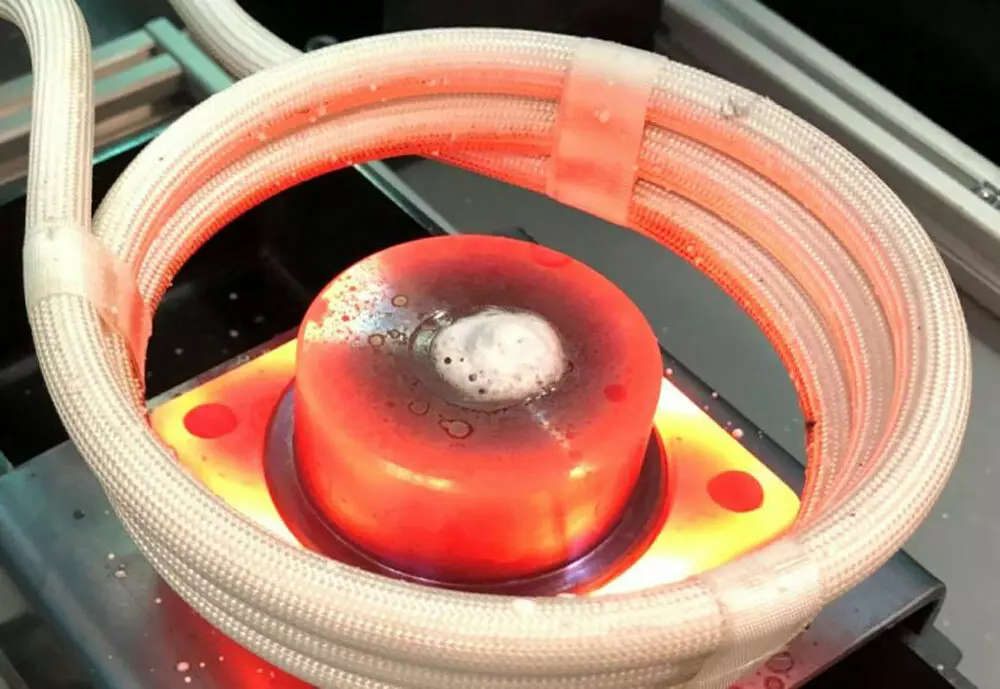
If you’re under pressure to increase production throughput and significantly improve product consistency and repeatability, adding automation is often one of the most impactful changes you can make.
With automation, however, comes a series of decisions:
- What level of automation is right?
- Should I go with a semi-automatic hand-feed method, or go with a fully automated solution?
- Do I need to upgrade the existing production lines by implementing automation?
- Partially employing equipment you already have may be more palatable to management and give you more leeway for new capital automation equipment expenditure
The objective of this guide is to present Practical Automation Solutions for various application requirements such as:
- Brazing
- Soldering and Desoldering
- Annealing
- Hot Forming
- Stress Relieving for Pre-and for Post Weld operations
If you’re ready to implement automated induction heating in your system, explore our induction automation services page, or contact our expert team.
Is Automation a Fit for my Induction Needs?
Not every induction operation benefits equally from automation. Some benefits clients have found when automating their induction heating operations include:
- Higher-volume production & increased production throughput
- Tight quality control and reduced scrap/rework
- Inductronix equipment offers true integrated data logging for even tighter control
- Reduced potential for operator error
- Consistency and repeatability
- Optical pyrometers can be added for accurate temperature measurement.
- Potential labor and employee liability savings
- Potential tax benefits
Choosing the Right Level of Automation
You don’t necessarily need to go all-in on fully automating your manufacturing processes. Various levels can have immediate benefits and ROI, including:
- Manual assist: Automated controls with a skilled operator for part placement and visual confirmation. Less is more: you can take small steps to improve your existing production line, such as adding fixturing to self-locate the workpiece into the induction heating coil.
- The next step could be to add an Optical Pyrometer to control power for accurate and consistent heating
- Semi‑automatic: Automate just one or two steps of the induction heating operation, increasing efficiency while maintaining manual control
- Fully automatic: Induction machines self-place and remove parts in need of heating to and from the coil
- Additional Features
- In some cases, we can add our Dual/Simultaneous Output to power two coils at the same time, doubling production throughput and reducing the total net heating times
- Where applicable, we can add closed‑loop temperature control, data-logging, in‑station inspection, and auto‑reject
Deciding Between a Retrofit or a New System
Retrofitting your existing production line can initially justify ROI if your induction power supply is automation-ready. However, there are several variables to consider:
Compatibility
Take into account available kW/kHz, coil geometry constraints, cooling capacity, and the ability to expose control I/O and communication to a Programmable Logic Controller (PLC). If your current equipment can’t support recipe management, temperature feedback, or dual‑output configuration, the integration cost might erase any retrofit savings.
Communication
Your induction generators need to provide all the relevant I/O remote signaling for communicating between the generator and your PLC. All Inductronix Generators come with the following Automation-Ready features:
- All relevant Input-Output Signaling
- Plug ‘n’ Play Optical Pyrometer: You can use ours or your own existing pyrometer (subject to compatibility)
- 3rd Party thermocouple
- Various Fieldbus options (e.g., remote Fieldbus)
- Our own Remote Communication Protocol
- Generator’s display can be viewed on your laptop using an RJ45 Ethernet Connection
- Generator’s output power, current, and temperature can be monitored, and temperature can be set from PC
- Power and temperature settings can be changed remotely
Process Control
You will want to have automation-ready communication protocols that can adjust for power, time, and/or temperature depending on workpiece dimensions, material, and overall geometry. Real-time data-logging can confirm and prove your process or help improve it.
Physical Workspace
Footprint
Consider floor space and material flow. Retrofitting an existing footprint could be highly beneficial, but may not be practical.
Does your induction system offer remote heating heads so the heating coil can be positioned perfectly, even if the main generator and chiller are far from the workstation?
Some induction machines do not offer remote heating head flexibility, and coils must be connected directly to the generator, limiting the ability to have the coil positioned right at the workpiece in any x, y, or z axis.
You’ll also want to leave space between equipment so there’s room to do any relevant maintenance work. Inductronix generators offer small-footprint remote heating heads with cable lengths over 10 meters with no loss of power.
Temperature
How hot can your plant get at peak times in the summer? Similar to most electrical equipment, the recommended ambient temperature cap for induction and automation equipment is 95°F. Any higher than that, and you may want to look at increasing the size of the chillers for your induction generators.
Unintended heating
Don’t forget that induction coils heat metal. If your fixturing or infrastructure is metallic, ensure the heating coils don’t have the opportunity to heat something they shouldn’t, like metallic railing or tables. You want the power concentrated on heating the workpiece.
Power
Most equipment runs on 480V. Do you need to wire/rewire your plant for 480V? If needed, Induction Technology Solutions can provide a Generator with 220Vac. 3-Phase.
Sensors and Controls That Matter (And Those That Don’t)
Having the right measurement and control systems for your automated induction heating process is important, but not every add-on will be right for your specific application. We can gladly guide you toward equipment that is suited for your specific requirements.
Temperature Measurement/Pyrometry
Infrared (IR) Pyrometry is the standard for non‑contact temperature feedback in induction. These sensors measure thermal radiation to determine part temperature without needing to use temperature paints.
Temperature Monitoring & Control Options
- Target Temperature Setting: Turn Power On. Once the target temperature has been reached, the Pyrometer would turn the “heat” off.
- Power, Time & Temperature: You can set your target, power, and time.
- Ramp-Up, Soak, and Ramp-Down: You can set the Pyrometer to Ramp-Up to heat a part to its target temperature, Soak at a predetermined time, and then Ramp-Down
- Presets: The Generator’s Control Panel is fully User-Programable, with an easy-to-use alphanumeric interface.
Key steps for successful implementation:
- Select measuring spot size relative to your smallest heat zone: Typical spots range from 3-5mm for small brazed joints up to 25mm for larger assemblies. Once selected, ensure that your equipment consistently measures at that same spot.
- Choose the correct wavelength for the material and surface finish: Reflective surfaces (i.e. emissivity) and Aluminum, in particular, can be challenging.
- Clean sensors periodically
Closed-loop Temperature Control
Closed‑loop temperature control can significantly improve quality control. This automated feedback system adjusts heating parameters in real-time based on actual temperature readings.
A Programmable Logic Controller (PLC) or motion controller should coordinate all process steps: heat on/off, coil approach, filler dispense, and cool-down. The system should log setpoints and actual values at a useful frequency (typically 10Hz or faster) for Statistical Process Control (SPC).
Recipe management is crucial for repeatability. Use human-readable names, version tracking, and access control to prevent unauthorized changes. Include validation procedures for any recipe modifications.
Data Logging & Traceability
Data logging is absolutely worth implementing for quality control, improvement, and troubleshooting. Essential parameters to capture include:
- Temperature vs. time curves
- Power output levels
- Dwell times at temperature
- Pass/fail results
This data can be summarized at the lot level for traceability.
Dual‑Output systems
Run Single and/or Dual Simultaneous output power mode for powering two coils/stations from one induction generator.
- Example of Dual‑output with overlapped tasks: While Station A heats, Station B loads/unloads, increasing throughput and introducing redundancy.
Contact one of our experts for further details.
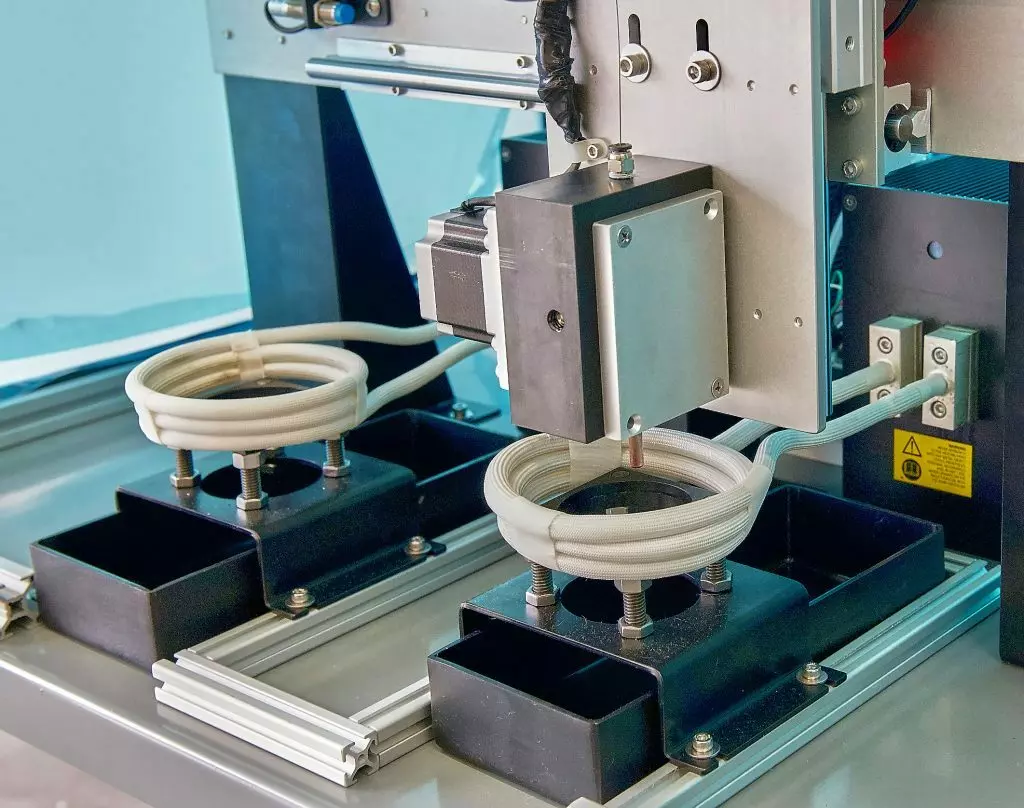
Common Pitfalls in Automating Induction
- Over‑customization: Tailoring everything increases cost and lead time
- Solution: Standardize components such as sensors, actuators, and guarding, and modularize fixtures
- Skipping prototyping: Building a full production system before validating your process wastes time and money
- Solution: Test your heating process on a small scale first to verify that parts heat evenly and brazing material flows properly
- Ignoring ergonomics: Even semi‑auto cells can create awkward reaches or pinch points.
- Solution: Mock up reach envelopes and heights early.
- Under‑scoped controls: Leaving out recipe management, interlocks, or data logging to “save” cost usually backfires.
- Solution: Include these features from the start that are essential for quality and troubleshooting.
- Neglecting changeover: Poor changeover design turns product switches into lengthy downtime.
- Solution: Design for tool-less or single-tool changeover with positive locators to reduce changeover from minutes to seconds.
- Forgetting serviceability: Cramped designs make maintenance difficult and expensive.
- Solution: Leave room to swap coils, clean sensors, and perform maintenance without disassembling the cell.
FAQs
Do I always need an IR pyrometer for closed‑loop control?
Not always, but it’s the most direct feedback for temperature and repeatability in an automated production environment. For some joints, consistent power‑time with verified results is sufficient; for critical joints or variable mass/fit‑up, closed‑loop pyrometry is worth it.
What’s the minimum data I should log?
Start with job/lot ID, recipe version, pass/fail, peak temperature (or power/time surrogate), and a timestamp. Add detailed curves if you’ll use them for Statistical Process Control (SPC) or customer reporting.