
Automated Induction Heat Treating Systems
In-House Solutions for Steel Processing
Many of our customers sent their products to outside heat-treaters for induction heat treating, but more and more, manufacturers are considering bringing their heat treating back in-house.
There are many reasons to move heat treating in-house, such as:
- IP Protection: The manufacturer wants to have tighter control over their intellectual property and trade secrets.
- Quality Control: The manufacturer wants to have tighter quality control over the process and avoid having parts damaged in shipping to/from the heat treater.
- Cost Saving: The manufacturer wants to control costs. Often outsourcer and shipping prices increase every year.
- Switching to Induction: The manufacturer wants to switch from expensive oven heat treating furnaces to energy-efficient, cost-effective induction heating.
Considering bringing your heat treating back in-house and considering automated induction systems but need to know more? This quick guide can help.
Understanding Automated Induction Hardening Systems
The Induction Hardening Process
Induction hardening strengthens steel by creating a martensitic microstructure through precise temperature control and rapid quenching. Automated systems deliver:
- Precise Temperature Control: IR sensors maintain ±5°C accuracy
- Consistent Results: Automated recipes ensure repeatability across production runs
- Energy Efficiency: Up to 85% energy transfer efficiency vs. 45% for gas furnaces
- Localized Heating: Target specific zones without affecting surrounding material
- Rapid Processing: Heat parts in seconds rather than hours
- Minimal Footprint: Systems require 75% less floor space than conventional furnaces
Induction Tempering: Automated Stress Relief
While hardened steel is very strong, uneven cooling can cause microscopic stresses. Reheating, or tempering, the steel can correct these micro stresses and result in more durable material. Automated induction tempering systems offer:
- Single Equipment Solution: Use the same induction system for both hardening and tempering
- Programmable Power Control: Automatically adjust power levels for different process stages
- Consistent Material Properties: Achieve uniform durability across all parts
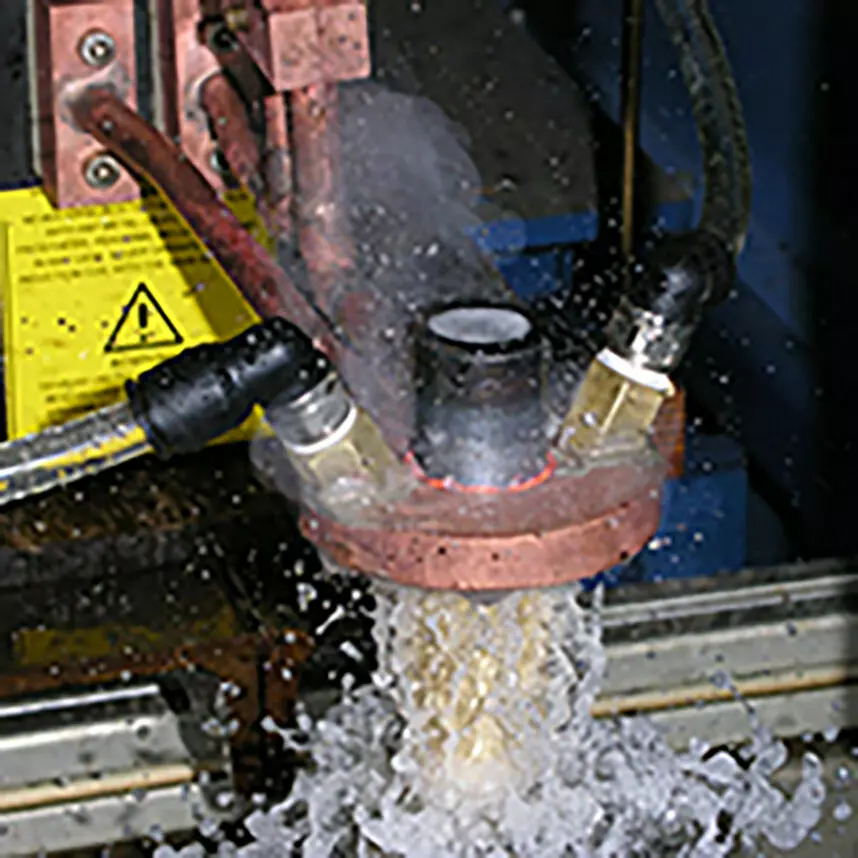
Induction Heat Treating, Heat & Quench
Advanced Automation: Zone Hardening and Scanning Systems
Automated Zone Hardening
The beauty of induction heating is that the heat can be localized by positioning the induction coil right at the part of the workpiece (zone) to be treated without affecting the rest of the workpiece.
Robotic positioning systems enable precise localized heat treatment:
- Program-specific heating zones
- Maintain untreated areas for subsequent machining
- Reduce material distortion
Automated Scanning Systems
When a workpiece is too long to effectively heat treat the entire length at once, it is efficient (and economical!) to use a process called “scanning”. This involves heat treating the part a section at a time until the entire length is heat-treated.
For long workpieces, automated scanning delivers uniform treatment:
- Coil Movement Systems: Servo-controlled coil positioning along stationary parts
- Part Movement Systems: Conveyor or indexing systems move parts through stationary coils
- Synchronized Quenching: Automated spray follows heating zone
- Production Rates: Process speeds up to 500mm/minute depending on material thickness
For more information about heat treating workable lengths, please contact us.
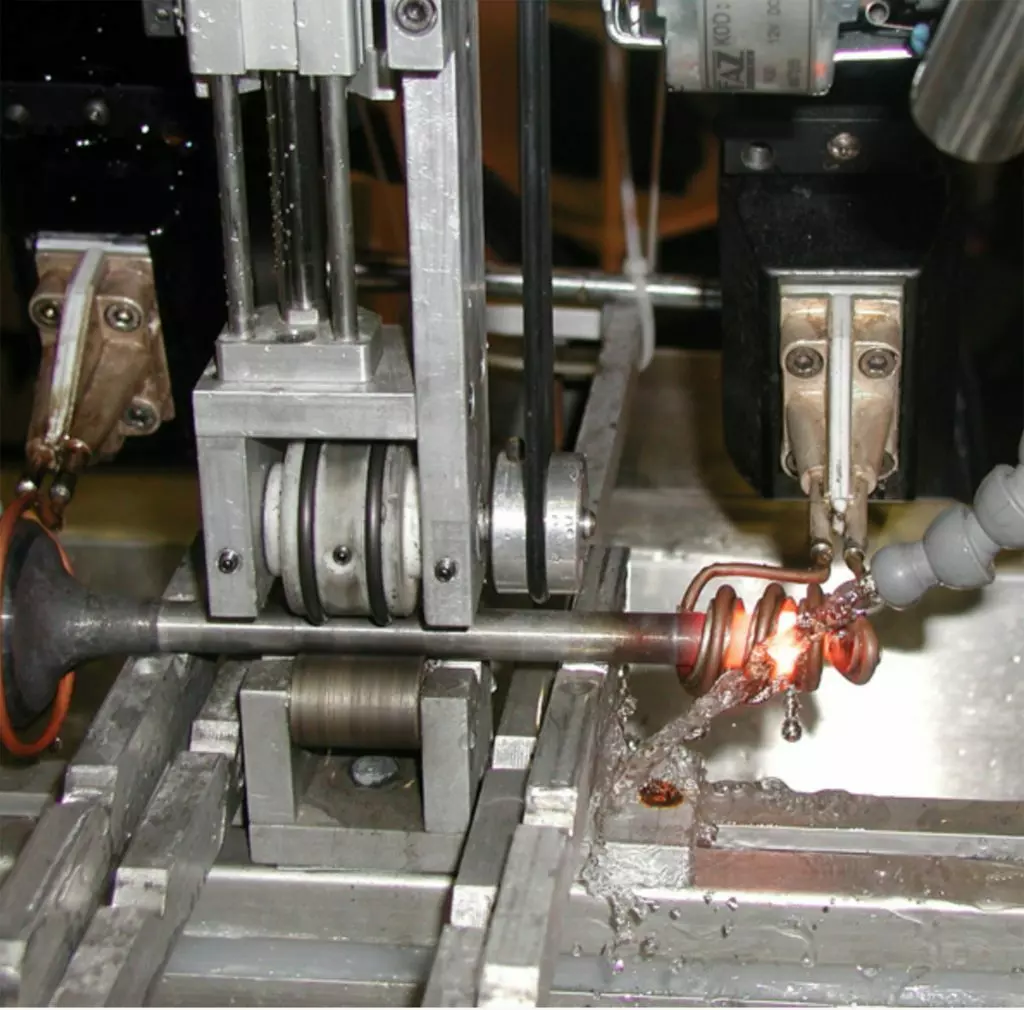
Induction Heat-Treating Scanning Method
Temperature Monitoring and Control Systems: How Do I Know I’m Heating My Metal to the Right Temperature?
The most effective way to monitor temperature is by using an infrared (IR) temperature sensor. Optical IR pyrometers can coordinate with and control the induction power supply, cutting power automatically when the workpiece has reached the desired temperature.
Optical Pyrometers (IRs) offer:
- Non-Contact Measurement
- Real-time surface temperature measurement
- Closed-Loop Control: Automatic power adjustment maintains constant temperature control in real-time.
Complete Automation Solutions for Induction Heat Treating
Our high-performance induction heating systems can easily integrate with automation to ensure your heat treating process runs smoothly and efficiently.
Material Handling Automation
- Loading/Unloading: Integrate with existing production cells
- Conveyor Systems: Continuous or indexed movement through treatment zones
- Part Recognition: Vision systems identify part types for automatic recipe selection
- Buffer Storage: Accumulation systems manage production flow
Process Automation Features
- Recipe Management: Store and recall parameters for different part numbers
- Quality Monitoring: True real-time data collection for quality control purposes.
Selecting the Right Induction Power Supply
Critical Performance Factors
High-performance induction power supplies must handle:
- Curie Point Transitions: Automatic adjustment when steel loses magnetic properties at 770°C
- Load Matching: Dynamic tuning as material resistivity changes during heating
- Frequency Optimization: Adjust frequency for optimal heating depth
Integration Capabilities
Modern induction power supplies offer:
- Industrial communication protocols (EtherNet/IP, PROFINET)
- Remote monitoring and control
- Comprehensive diagnostic capabilities
ROI and Implementation Considerations
Automated induction heat treating systems typically deliver:
- Energy Cost Reduction: 50-80% lower than gas furnaces
- Quality Improvements: Reduced scrap rates through consistent processing
- Return-on-Investment: 12-24 months for most applications
Next Steps: Implementing Your Automated Solution
Transitioning to automated induction heat treating requires careful planning. Our expert engineering team can work with your team to provide application-specific insight into how induction can transform your heat treating process. Contact us today to learn more.